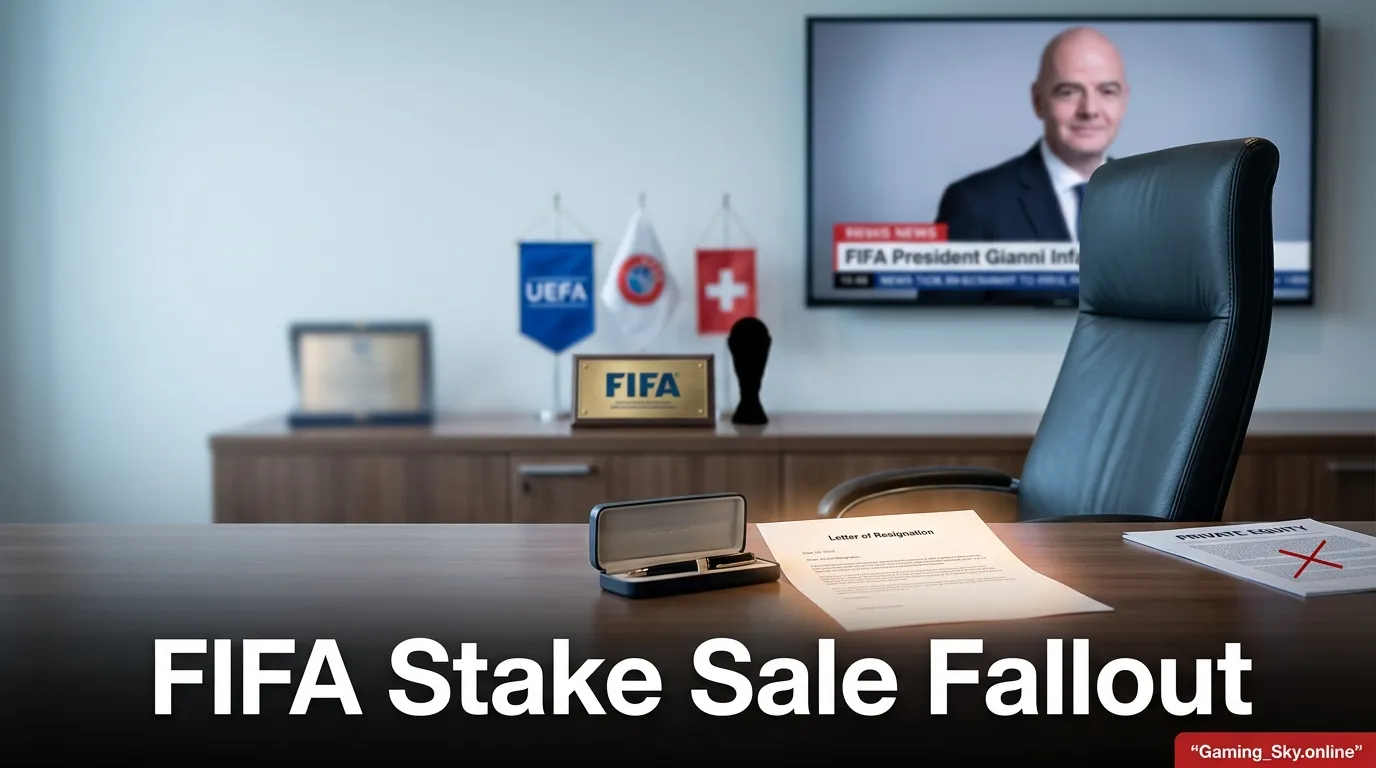
A senior adviser to FIFA President Gianni Infantino resigned in protest on Friday as European football’s governing body threatened a full boycott of FIFA competitions. The flashpoint is Infantino’s plan to create a $20 billion commercial subsidiary and sell a minority stake in the commercial rights to the World Cup and other major tournaments to private investors.
Carlos Cordeiro, a former president of U.S. Soccer and longtime Infantino adviser who also sat on the White House World Cup task force, quit with immediate effect. He called the proposal “a bad deal for FIFA’s member associations, a bad deal for football, and a bad deal for the long-term future of the game.” Hours earlier, UEFA and its 55 member nations had voted unanimously to refuse participation in any FIFA tournament unless the plan is abandoned entirely and binding assurances are given that private ownership of competitions will never return.
The crisis erupted days after media reports forced FIFA to confirm the scheme. It has already drawn formal opposition from CONCACAF and the Asian Football Confederation, isolating Infantino and raising questions about the future of his presidency.
What FIFA Actually Proposed
FIFA wants to establish a new company, FIFA Forward Enterprise (FFE), that would take control of commercial and event operations for the men’s and women’s World Cups, the Club World Cups and other competitions. Broadcast rights, sponsorship, ticketing and licensing would sit inside this vehicle.
FIFA would keep majority ownership and full authority over sporting and regulatory decisions. Investors would receive a non-controlling stake of up to 20 or 21 percent. FIFA and its advisers valued FFE at roughly $20 billion, which would generate about $4.2 billion in fresh capital if the stake is sold.
That money is meant to fund a new “Fast-Forward” development programme. Member associations that approve the plan would receive significantly higher payments than those that reject it. Figures circulating among federations include an immediate optional $20 million per association plus stepped increases through 2038. FIFA has said associations that vote against the plan would still receive baseline Forward funding, though at lower levels.
The expected lead investor is Thrive Eternal, an investment vehicle set up by Joshua Kushner, younger brother of Jared Kushner. JPMorgan has advised FIFA on the structure and valuation. Former Liberty Media executive Greg Maffei has also been involved as a commercial adviser.
FIFA insists the proposal requires majority approval from its 211 member associations and endorsement by the FIFA Council. A decision deadline of mid-September has been set. In a statement on Friday the organisation said “nobody is selling football” and that the consultation process would continue so members could vote “based on facts.”
Why the Resignation Matters
Cordeiro’s departure carried unusual weight. A former Goldman Sachs banker who spent decades in finance and football administration, he had been one of Infantino’s trusted inner-circle figures since 2021. He stressed he had no involvement in drafting the plan and only learned of its details when they became public.
In his resignation statement he asked basic questions that many federations are now repeating: Why this deal? Why now? What oversight exists? Who benefits? Was there a competitive process? What will investors ultimately gain, and at what cost to the game?
FIFA’s chief operating officer, Kevin Lamour, issued a separate and equally sharp critique, saying staff had been “deceived” by the lack of openness and that the project “is the project of one person.” The dual public break from senior figures inside FIFA itself marks a significant escalation beyond confederation statements.
Europe’s Boycott Threat and Broader Opposition
UEFA’s language left little room for compromise. After an emergency virtual meeting of its 55 members, the organisation declared that no UEFA national team would take part in any FIFA competition “for so long as these proposals remain alive.” The boycott would cover men’s and women’s World Cups, youth tournaments, the Club World Cup and other events.
“The World Cup cannot be treated as an investment product,” UEFA said. “It is one of football’s greatest sporting legacies. No part of it should ever be surrendered to private investors. The World Cup is not for sale.”
CONCACAF rejected the plan on similar grounds of transparent governance and long-term stewardship. The Asian Football Confederation expressed “deep concern,” stood with UEFA and CONCACAF, and called for an urgent review of FIFA’s decision-making processes. The speed and breadth of the regional pushback have left Infantino with limited institutional cover.
The next FIFA competition on the calendar is the women’s Under-20 World Cup in September. Hosts Poland said they had received no formal notice of any withdrawals, but the threat now hangs over every future tournament.
The Deeper Tensions This Exposes
The dispute is not only about money. It revives a long-running struggle between FIFA and the European confederation over who controls the sport’s richest assets and how revenue is distributed. Europe generates the bulk of global football’s commercial value through its clubs and leagues. FIFA, under Infantino, has repeatedly argued that smaller associations outside Europe deserve a larger share of the pie.
Critics of the current plan argue FIFA already sits on substantial reserves and could fund development without permanently attaching private equity to the World Cup’s commercial engine. They also question the secrecy of the process. Even some European members of the FIFA Council reportedly learned of the full proposal only through media reports.
Supporters of the idea, mostly outside Europe, see the extra cash as transformative for grassroots programmes in regions where national associations depend heavily on FIFA grants. That divide between cash-rich European federations and cash-hungry associations elsewhere is precisely the political calculation Infantino appears to have made.
What Happens Next
FIFA has said it will continue the consultation and will not create the subsidiary without majority support. UEFA’s boycott threat is conditional on the plan remaining alive. If enough non-European associations back the proposal, FIFA could claim democratic legitimacy even while Europe stays away. A World Cup without the strongest national teams would, however, carry severe sporting and commercial consequences.
Infantino faces his most serious internal challenge in years. Two senior figures have publicly broken with him. Three of the six confederations have rejected the core idea. The September deadline for member associations to decide gives both sides a short window to negotiate, escalate or climb down.
For the moment the central fact is clear. A plan intended to unlock billions for football development has instead produced the sharpest open conflict between FIFA’s leadership and European football in more than a decade, a high-profile resignation, and an explicit threat to empty the World Cup of its strongest participants.