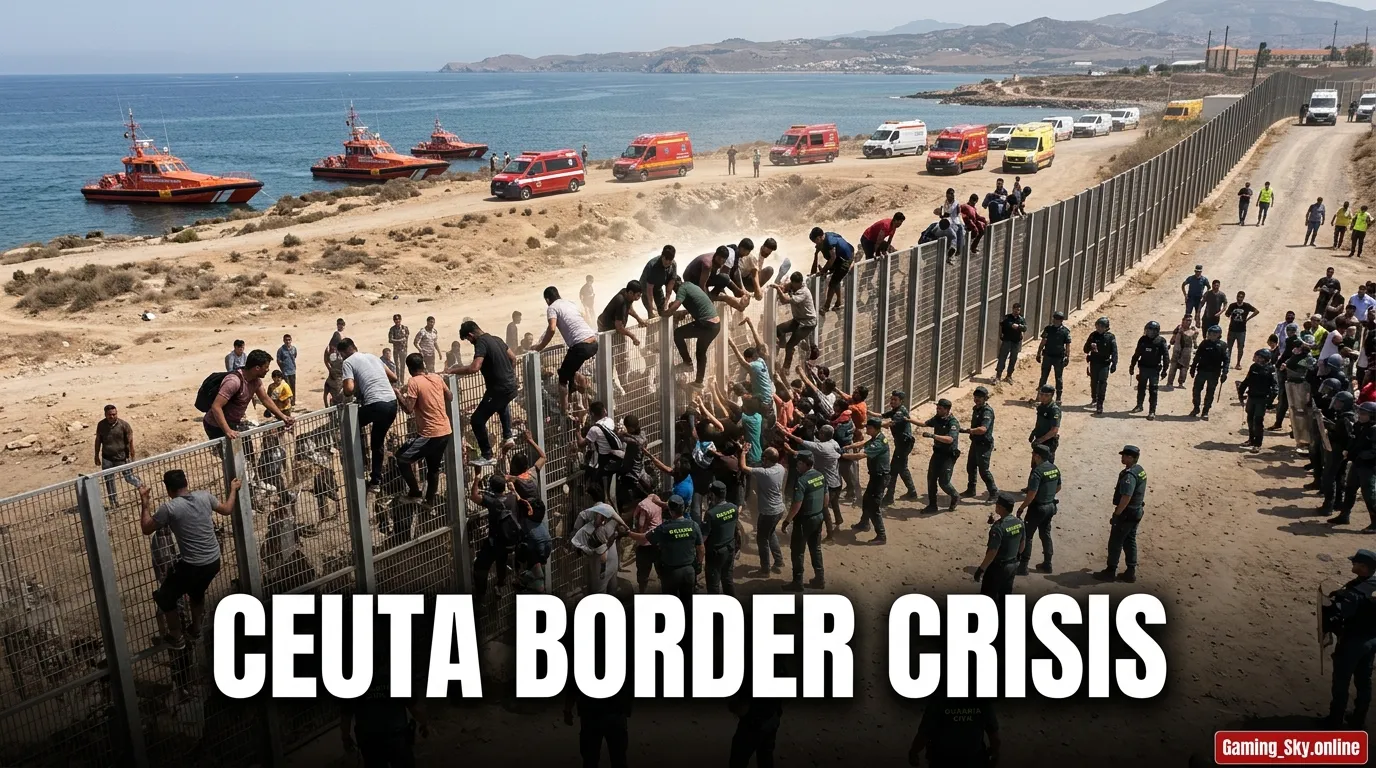
Tens of thousands of people surged from Morocco into Spain’s North African enclave of Ceuta within hours on Thursday, creating one of the largest single-day irregular border crossings in recent European history. Local authorities estimated as many as 60,000 arrivals, a figure approaching 70 percent of the city’s usual population of roughly 83,000 to 85,000. At least several dozen people died, many by drowning or in the crush near the breakwater at Tarajal beach.
Spanish Prime Minister Pedro Sánchez traveled to Ceuta on Friday, describing the influx as a “violation of Spain’s territorial integrity.” He ordered additional police and military units into the territory and pledged rapid returns. By Friday afternoon, Spanish officials reported that more than 37,500 of those who crossed had already turned back voluntarily to Morocco, with some later counts placing the figure above 48,000.
The scale dwarfed previous episodes at the same frontier, including the 2021 crisis that brought roughly 10,000 to 12,000 people into Ceuta over several days.
What Happened at the Border
Most of the arrivals were young Moroccan men, though women, children and some non-Moroccans also crossed. Many swam or waded around the rocky breakwater that marks the maritime edge of the border fence. Others pushed through land gates or scaled barriers. At the peak, witnesses and local officials described people arriving at a rate of roughly 200 per minute.
Spanish border forces were quickly overwhelmed. Reception centers filled. Parks and streets became overnight sleeping areas. Videos circulating online showed crowds running into the city in swimwear or light clothing, some celebrating on the sand.
Moroccan security forces later used water cannon and tear gas on the other side of the fence in the town of Fnideq to push people back. Spain closed the border post at its second North African enclave, Melilla, as a precaution after several hundred people attempted to enter there as well.
The Death Toll and Immediate Human Cost
Local officials and Spanish security sources reported recovering bodies from the water and near the breakwater. Early counts ranged from the high teens to the mid-30s. Later figures cited by Spanish media and regional authorities climbed as high as 57. Some deaths resulted from drowning; others occurred in the stampede as people climbed the rocks and fence.
One migrant who had already decided to return told reporters the scene was grim. “People are dying here,” he said. “I beg you, please, if you haven’t come yet, don’t come.”
The city of Ceuta had no immediate capacity to feed or house the numbers that arrived. Local president Juan Jesús Vivas called the situation “absolutely unsustainable” and appealed for national support.
Why the Crossing Happened Now
Spanish authorities linked the sudden surge to a recent Supreme Court ruling. The court determined that migrants intercepted at sea while trying to reach Ceuta or Melilla could not be returned under the special “border rejection” procedures that apply to those who cross by land or climb the fence. The decision created a legal distinction that, according to Sánchez, was exploited by human trafficking networks.
“What has emerged from our talks with Moroccan authorities is that trafficking mafias took a self-serving interpretation of a Supreme Court ruling” that “spread like wildfire,” Sánchez said in Ceuta. Social media amplified the message. Young people in Morocco shared videos and routes, and calm summer seas made swimming around the breakwater more feasible than in rougher months.
Economic pressures inside Morocco and long-standing patterns of irregular movement toward the European Union also played a role. Ceuta and Melilla form the EU’s only land borders with Africa. They have seen repeated surges for years, but nothing on this scale in a single day.
Spanish officials noted that overall irregular arrivals to mainland Spain had actually fallen in the first half of 2026 compared with the previous year. The pressure concentrated almost entirely on Ceuta.
Spain’s Response and the Return Flow
Sánchez and Interior Minister Fernando Grande-Marlaska arrived in Ceuta on Friday morning. The government deployed hundreds of specialized police officers and dozens of soldiers to reinforce the Civil Guard. Officials said they would accelerate expulsions of those who entered illegally while complying with the court ruling. Plans include placing a visible line of buoys near the Tarajal breakwater so the maritime border is clearer.
Morocco cooperated in the return process. By late Friday large numbers of people were walking back through border gates. Spanish authorities released video of the voluntary departures. The rapid reversal limited the long-term population impact on the enclave, yet the political and logistical shock remained.
European Reactions and Wider Implications
The images of thousands arriving in a single day triggered sharp criticism from other European governments. Italy announced it would suspend the Schengen free-movement arrangements with Spain, arguing that the influx threatened the integrity of the open-border zone. Other right-leaning politicians across the continent called for stronger external controls and questioned Spain’s capacity to manage its southern frontier.
The European Commission offered operational support through Frontex, the EU border agency. The episode revived familiar debates about externalization of migration control, cooperation with North African partners, and the limits of national asylum and return systems when numbers spike so dramatically.
For residents of Ceuta the practical effects were immediate: overcrowded public spaces, stretched emergency services, and heightened tension. Businesses near the border and the city’s summer tourism calendar faced disruption. For the Spanish government the crisis tested both its left-leaning migration stance and its ability to coordinate with Morocco at a moment of high visibility.
What Comes Next
Authorities appear to have stemmed new arrivals for now. The combination of reinforced Spanish forces, Moroccan crowd control and the visible return of tens of thousands has reduced the immediate pressure. Yet the underlying drivers remain: economic disparity, the legal distinction created by the court ruling, the role of smuggling networks, and the structural vulnerability of two small Spanish territories on the African mainland.
Sánchez promised to use “all the instruments of the state” to restore security and normal life in Ceuta. Whether that includes permanent physical changes to the maritime border, tighter operational cooperation with Rabat, or adjustments to return procedures will become clearer in the coming days. For the moment the enclave is still absorbing the aftershocks of a border event that, by official estimates, briefly added a population nearly as large as the city itself.