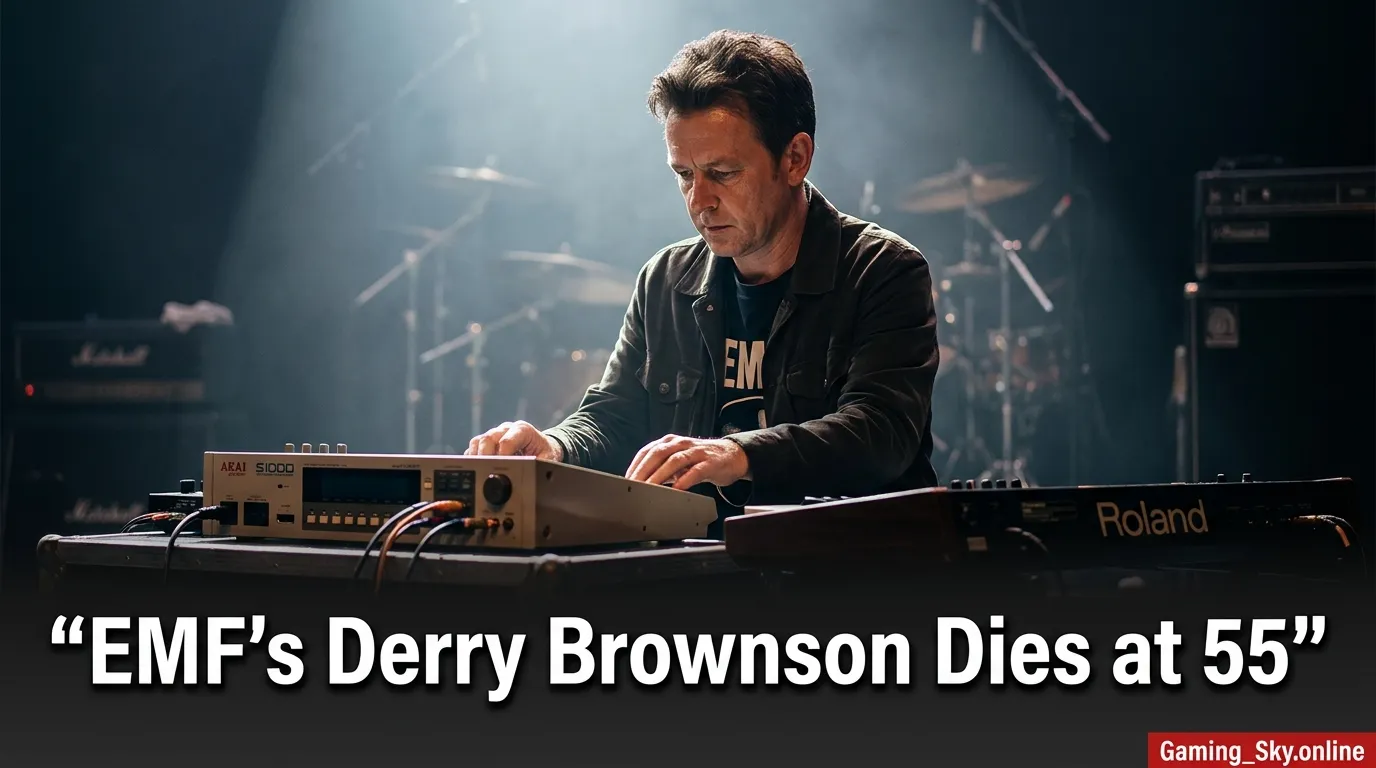
Derran “Derry” Brownson, founding keyboardist and sampler of the British alternative rock band EMF, has died at the age of 55. The musician passed away on Thursday, August 13, 2026, after being diagnosed with a cancerous brain tumour. His death was announced by the band the following day, prompting an outpouring of tributes from fellow musicians and fans who remembered him as a vital force behind one of the defining dance-rock hits of the early 1990s.
EMF, best known for their 1990 single “Unbelievable”, formed in the small Gloucestershire town of Cinderford in 1989. Brownson helped shape the group’s distinctive blend of indie guitar, electronic samples and club energy that briefly conquered charts on both sides of the Atlantic. His passing closes a chapter for a band that never fully faded from view, even as its members moved through reunions, new recordings and the natural passage of time.
The Band’s Immediate Tribute and the Final Months
EMF shared the news in a heartfelt social media post. “Late last night we started to hear the news that we have lost our Brother In Arms Derran Brownson,” the statement read. “We are devastated, the only solace we can find is that we are eternally grateful Derry was able to join us on stage a couple times just a few short months back. Nothing will ever be the same again without our band mate and friend, fly high brother Derry.”
Brownson had publicly discussed his diagnosis in July 2025 while preparing for a hometown appearance at Cindyfest in Cinderford. He told the BBC he had undergone surgery to remove part of the tumour and praised the care he received from the NHS as “absolutely above and beyond.” At the time he described the situation as “just a battle really,” adding that returning to the stage in the town where it all began meant a great deal to him.
He managed several performances after that interview. Bandmate Ian Dench later recalled that Brownson was still exchanging jokes by text only weeks before his death. His final appearance came in May 2026 in Frome. Dench summed up the man many remembered: “I can’t think of anyone who embodied lust for life like Derry did. I mean, he was beautiful inside out.”
From Cinderford Village Halls to International Stages
Born in 1971 in Cinderford, Brownson grew up in the Forest of Dean. Before EMF he played in a local band called Flowerdrum. In 1989 he joined forces with vocalist James Atkin, bassist Zac Foley, drummer Mark Decloedt and DJ Milf. Guitarist and primary songwriter Ian Dench completed the classic lineup shortly afterward.
The group took its name from “Epsom Mad Funkers,” a phrase once used to describe New Order fans, though the letters long invited more colourful speculation. They signed to EMI after only a handful of shows. Rehearsals often took place in informal spaces around Cinderford, including rooms connected to Brownson’s family. The chemistry was immediate. Dench has recalled writing early material, including the core of “Unbelievable,” in that setting.
Brownson’s role as keyboardist and sampler proved central to the band’s sound. While Dench supplied the melodic and structural backbone, Brownson brought the electronic textures, loops and found-sound samples that gave EMF its club-ready edge. That combination of live-band energy and dancefloor production helped the group stand out in the early 1990s indie-dance crossover scene.
The Breakthrough That Defined a Moment
“Unbelievable” arrived in late 1990 and quickly became impossible to escape. It peaked at number three on the UK Singles Chart and, more remarkably, climbed to number one on the Billboard Hot 100 in the United States in the summer of 1991. The track sampled comedian Andrew Dice Clay and performance poet Gylan Kain, folding those spoken fragments into a restless guitar riff and insistent beat. Its success turned EMF into unlikely American chart-toppers for a brief, bright window.
The debut album Schubert Dip, released in 1991, reached number three in the UK and earned platinum certification in the United States. Follow-up singles such as “I Believe” and “Lies” kept the momentum going in Britain and, to a lesser extent, across the Atlantic. Later albums Stigma (1992) and Cha Cha Cha (1995) produced further UK hits, including a collaboration with comedians Vic Reeves and Bob Mortimer on a cover of “I’m a Believer.”
By the mid-1990s the intense early fame had cooled. The original run ended around 1995–1997. Brownson later formed the alternative rock trio LK. Bassist Zac Foley died of a drug overdose in 2002 at the age of 31, a loss that left a lasting mark on the remaining members.
Reunions, New Music and a Return to the Stage
EMF never fully disappeared. The band regrouped periodically through the 2000s and 2010s for live dates. In the 2020s they returned to the studio, releasing Go Go Sapiens in 2022 and The Beauty and the Chaos in 2024. A 2024 North American tour marked their first substantial US run in more than three decades. Brownson took part when health allowed.
In May 2025 the town of Cinderford honoured the band with a blue plaque. Later that summer the group played the emotional hometown Cindyfest show that Brownson had spoken about with such clear affection. Even as he managed treatment, he remained connected to the music and the people who had shared the ride from the beginning.
At the time of his death the band had recently finished work on a new 14-song album, a project that now carries an added layer of poignancy.
What Brownson Brought to EMF and Why It Endures
Brownson’s contribution went beyond playing keys. He helped give EMF its restless, sample-driven personality at a moment when British guitar bands were absorbing house, techno and hip-hop influences. The result was music that felt both of its time and oddly timeless. “Unbelievable” still turns up in films, commercials and playlists more than three decades later, introducing new listeners to a band that once seemed to arrive fully formed from the Forest of Dean.
Those who knew him repeatedly return to the same qualities: energy, humour, generosity and an unfiltered appetite for life. In an industry that can reward calculation, Brownson appears to have operated on instinct and enthusiasm. That approach helped fuel the band’s early breakthrough and sustained the friendships that kept reunions feeling genuine rather than obligatory.
His death also serves as a reminder of how quickly the 1990s have receded into history. Many of the musicians who defined that era are now in their fifties and sixties. The losses accumulate. Yet the records remain, and with them the particular spark Brownson helped create.
Fans and fellow artists have already begun sharing memories of the bleach-blond keyboardist who once performed with the abandon of someone who treated every stage like a village hall back home. For a band that once rode a single song to the top of the American charts, that personal connection may prove the most lasting part of the story. Derry Brownson leaves behind a body of work that still sounds urgent, a hometown that claimed him as one of its own, and a circle of bandmates who counted him as a brother.