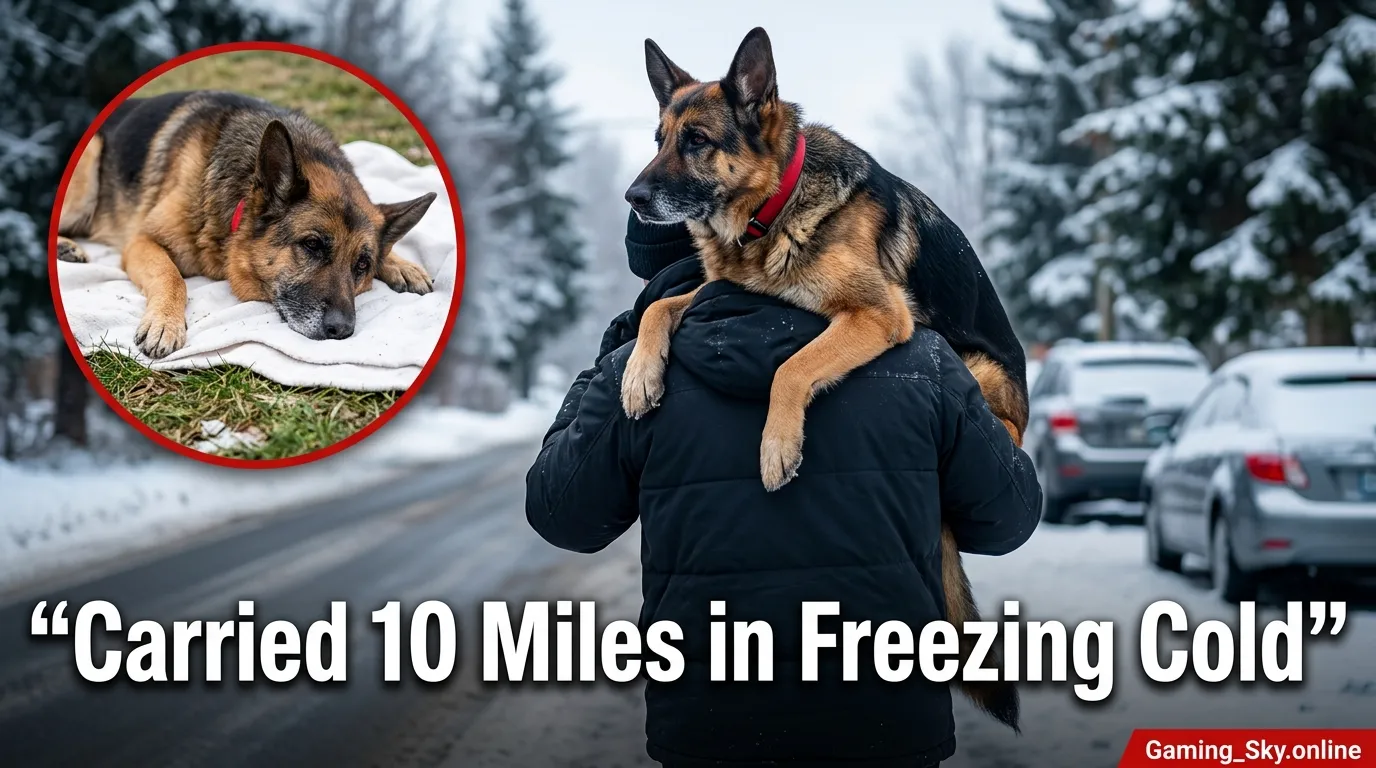
In the early days of Russia’s full-scale invasion of Ukraine, a family from Kyiv faced an impossible choice on a freezing road near the Polish border. Their elderly German Shepherd, too weak to keep walking, could not finish the final stretch on her own. Rather than leave her behind, they carried her roughly 10 miles through temperatures of about -7°C.
The dog’s name was Pulya, Ukrainian for “Bullet.” At 12 and a half years old, she had spent nearly her entire life with the family. When the time came to flee, they treated her the same way they treated every other member of the household.
The Decision to Leave Kyiv
Alisa Teptiuk, then 35, lived in Kyiv with her husband Dmytro, their two daughters, and Pulya. Her mother, sister, and their families were also part of the group that ultimately fled together. The day before the invasion began, Alisa’s father died unexpectedly at age 59. The family had not yet been able to bury him when Russian forces launched their attack on February 24, 2022.
As the situation in the capital deteriorated, the family packed what they could into a small Peugeot 307. Five adults, four children, and two dogs—Pulya and a younger dog named Kolt—squeezed into the car. They drove for 16 hours to a village roughly 140 kilometers from Kyiv. The roads were clogged. Progress was slow. Danger remained close even after they left the city.
Near the Polish border, long queues of vehicles made waiting in the car for several more days too risky. The family decided to cover the last stretch on foot.
Ten Miles in Freezing Darkness
They set out at 4 a.m. The temperature sat around minus seven degrees Celsius. The route took them over uneven ground, around hills, and across streams. The children cried from the cold. Alisa later described fighting the urge to cry herself. She had been the one who pushed for the border crossing, and she felt responsible for seeing it through.
Pulya managed parts of the walk but repeatedly collapsed. Every kilometer or so she would go down and struggle to rise again. The family stopped cars to ask for help. Some drivers refused and suggested leaving the dogs. Alisa and Dmytro rejected the idea immediately. In their view, the dogs were not luggage. They were family.
Dmytro lifted Pulya onto his shoulders and carried her for stretches of the journey. Alisa took a photograph of the moment without planning to share it widely. The image later spread across social media and news outlets, showing a man in winter clothes bearing the weight of a large, aging dog along a cold road.
Why They Refused to Abandon Her
Pulya had entered their lives when she was a puppy of about four months. Alisa had bought her on the first day of maternity leave. The dog had been present through ordinary family milestones and harder times alike. By the time of the escape she was gray-muzzled and slow, yet still a steady presence.
“Pulya is family,” Alisa explained in interviews after reaching safety. “She is old and grey after a lifetime with us. She has been through the happiest and saddest moments of life with us. She understands us and loves us and we love her very much.”
The family’s stance reflected a wider pattern seen in the early weeks of the war. Many Ukrainians who fled brought pets despite the added difficulty. Others were forced to leave animals behind and later searched for them amid the chaos. Stories of abandoned pets and of people risking extra hardship to keep animals with them both circulated widely.
Reaching Safety and What Followed
The family completed the walk and crossed into Poland with both dogs. Alisa later spoke from temporary accommodation there. She described Pulya as a symbol of continuity—one constant in a period of upheaval. The dog had survived the journey. The children and adults had survived it too.
Dmytro, like many Ukrainian men of military age, faced restrictions on leaving the country. Reports indicated he later returned to Ukraine while Alisa and the children remained in Poland for a time. The family’s immediate priority had been getting the most vulnerable members, human and animal, out of the path of the fighting.
The photograph of Pulya on Dmytro’s shoulders became one of the early visual emblems of civilian endurance during the invasion. It did not depict combat or destruction. It showed a quieter form of determination: the refusal to discard a dependent companion even when every practical argument favored doing so.
The Bond That Outlasted the Cold
Wars force people to measure what they can carry and what they must leave. In this case, an aging German Shepherd who could no longer walk the full distance was still carried. The physical effort was real. The temperature was punishing. The risk of delay was present. None of those factors outweighed the family’s sense of obligation.
Pulya’s story stands out because it is specific and documented through the family’s own words and the image Alisa captured. It also points to a broader truth visible in many refugee accounts from that period: pets often function as living links to the home and the life that had to be abandoned. Leaving them behind could feel like another form of loss on top of everything else.
The family reached safety. The dog that could not finish the walk on her own finished it in their arms. In the middle of displacement, cold, and uncertainty, that simple act of carrying became the story that traveled farthest.