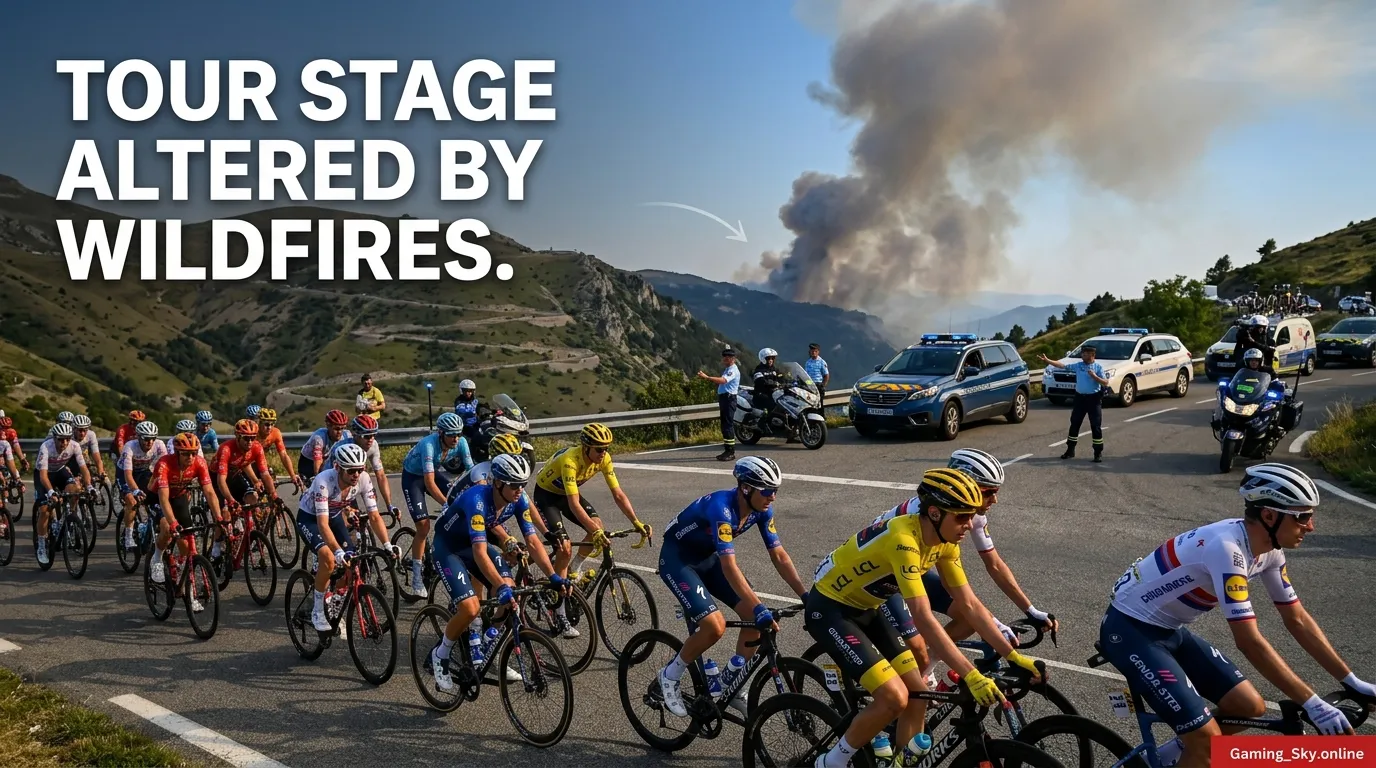
The Tour de France will end on a much shorter course than planned. Organizers cut Sunday’s final Stage 21 to just 89 km, featuring only two laps of the Champs-Élysées, after French security forces were pulled away to fight the massive wildfires still burning near Bordeaux.
Riders had just finished the demanding Stage 20 climb to Alpe d’Huez on Saturday when the announcement came. The original route from Thoiry into Paris was set for roughly 130 km with multiple circuits in the capital. That plan changed overnight as the wildfire crisis in southwestern France demanded more police, gendarmes, and military personnel.
Why Security Resources Shifted to Bordeaux
The wildfires around Bordeaux have forced more than 200,000 people from their homes in the Gironde and Landes areas. Flames moved toward the city’s western suburbs, including the airport zone, and threatened tourist sites and vineyards. French authorities declared the situation unprecedented and mobilized the army alongside civilian firefighters.
With so many emergency crews already stretched thin, race organizers and local prefects decided the full security detail needed for a longer Stage 21 parade through the Paris region could not be guaranteed. The Tour has always required heavy policing for crowd control, road closures, and the publicity caravan. Diverting those forces to the fire zones left little choice but to shorten the day.
The new 89 km format keeps the traditional finish on the Champs-Élysées but reduces the earlier mileage and cuts the number of full circuits in Paris. Two laps will still give the sprinters their moment and allow the yellow jersey wearer a ceremonial ride into the capital.
What Stage 20 Delivered on Alpe d’Huez
While the security decisions were being made, the peloton raced the queen stage of the 2026 Tour. Stage 20 started in Le Bourg-d’Oisans and finished at Alpe d’Huez after more than 5,000 meters of climbing. The route included the Col de la Croix de Fer, Col du Télégraphe, Col du Galibier, and the Col de Sarenne before the final ascent.
The day delivered the expected mountain drama. Climbers and general classification contenders tested each other on the high passes, and the finish on the iconic Alpe d’Huez slopes drew the usual large crowds. The result left the overall standings largely settled heading into the final day, which is typical for the last mountain stage of the race.
How the Shortened Final Stage Changes the Race
A standard final stage is mostly processional until the last 20 or 30 kilometers, when the sprinters’ teams take over. Cutting the distance to 89 km compresses that script. There will be less time for the usual celebrations and fewer chances for breakaways to form far from the finish.
The two Champs-Élysées circuits still offer the classic high-speed finish that fans expect. Riders will still pass the Arc de Triomphe and race along the famous avenue under the eyes of thousands of spectators. The shorter distance simply means less time on the road and a lighter security footprint outside central Paris.
Race director Christian Prudhomme and ASO officials have adapted stages before this year. Earlier in the Tour, wildfires in the Pyrénées-Orientales forced changes to Stage 3, including bans on roadside spectators and the publicity caravan. A heatwave later led to a 30 km cut in Stage 9. The Bordeaux crisis is the latest example of how extreme weather and fires are reshaping the event in real time.
Practical Impact on Riders and Teams
For the riders, a shorter final stage is mostly welcome after three hard weeks. Legs are tired, and many pure climbers or domestiques simply want to reach Paris safely. Sprinters still get their chance at a prestigious stage win on the Champs-Élysées, which remains one of the most sought-after victories of the season.
Teams will adjust their plans for the reduced distance. The usual long transfer and early start logistics change when the race is compressed. Support staff and soigneurs face a tighter schedule, but the overall physical demand on the athletes drops.
The Bigger Picture of This Tour
The 2026 edition has already dealt with heat alerts, earlier wildfires, and route adjustments. The decision to shorten the final stage underscores how stretched French emergency services have become during this summer’s fire season. Security that would normally protect the Tour’s closing parade is instead helping evacuate residents and contain flames near one of France’s major cities and wine regions.
Fans in Paris will still see the traditional yellow jersey celebration and the sprint finish. The atmosphere on the Champs-Élysées is expected to remain festive. The difference is that the race will arrive sooner and with fewer kilometers of buildup.
Organizers have made clear that rider and public safety come first. With the wildfires still active and resources redirected, the 89 km version of Stage 21 is the practical solution that allows the Tour to finish on schedule while freeing personnel for the more urgent crisis in the southwest.
Sunday’s shortened stage will close a Tour already marked by extreme conditions. The peloton will ride into Paris, complete two circuits of the Champs-Élysées, and end three weeks of racing under circumstances no one anticipated when the route was first announced.