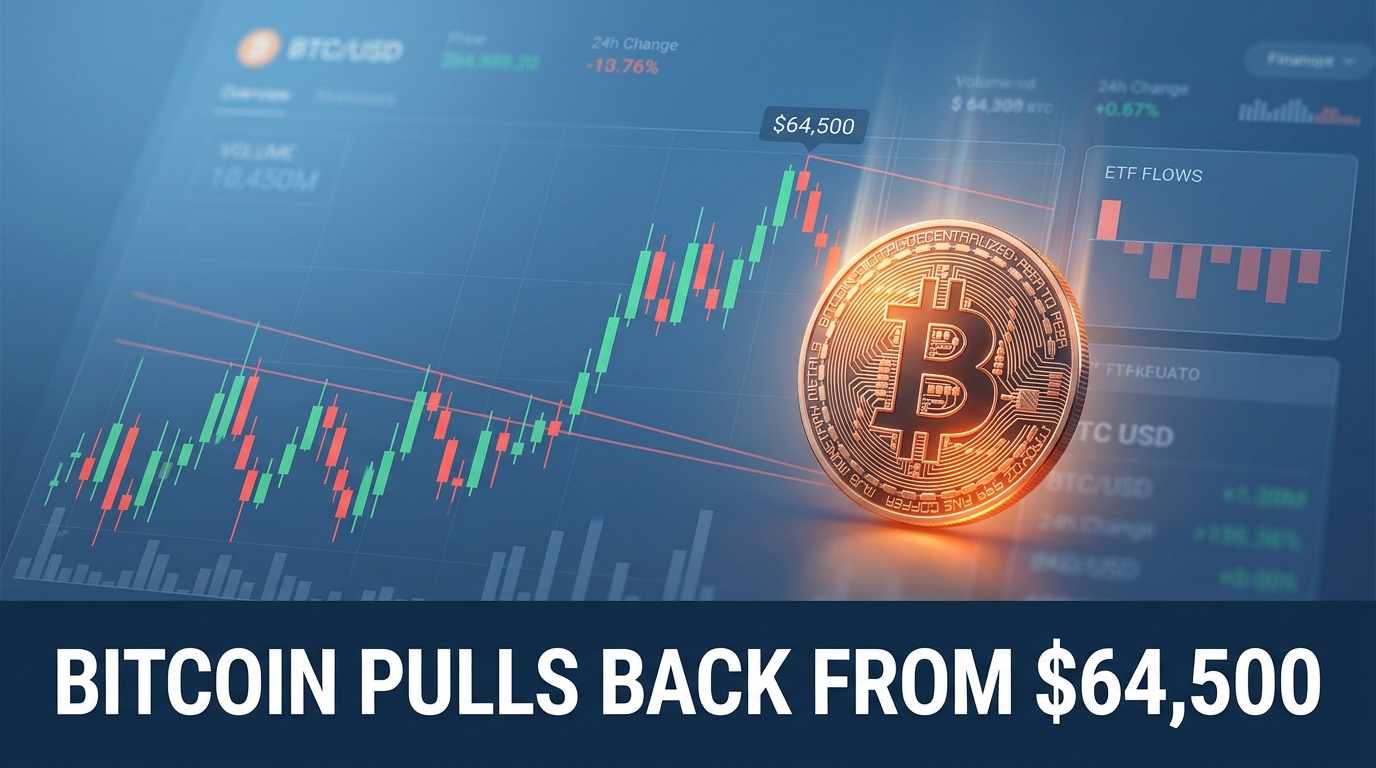
Bitcoin retreated from a two-week high near $64,500 as investors digested weakening demand from spot ETFs and signs of reduced speculative positioning. The move comes amid broader market caution, with falling open interest signaling some profit-taking after a decent July run. As of July 10, Bitcoin trades around the $62,000 to $63,000 range, giving back some of its recent gains.
This pullback highlights how sensitive the market remains to institutional flows. Spot Bitcoin ETFs, once a reliable source of buying pressure, have shown mixed or negative momentum lately. Traders are watching closely to see if this is just a healthy correction or the start of something more sustained.
The Recent High and Quick Reversal
Bitcoin climbed to around $64,500 earlier this week, its strongest level in over two weeks. That move capped an roughly 8% advance for the month so far. Yet the rally stalled quickly, with the price falling for the first time this month and breaking a streak of gains.
Several factors lined up. Weak ETF activity played a big role. After periods of inflows, recent sessions brought outflows or modest figures that failed to excite buyers. A negative Coinbase premium also pointed to softer spot demand in the U.S. compared to other markets.
Open interest in Bitcoin futures declined noticeably. This drop suggests traders unwinding leveraged positions rather than fresh money piling in. Without strong conviction from either side, the price lacked follow-through above the recent highs.
ETF Flows Lose Steam
Spot Bitcoin ETFs have been a major driver since their launch, but momentum has cooled. Recent weeks included stretches of outflows totaling billions, pushing the funds into net-negative territory for parts of 2026. While some days saw inflows, like around $221 million on one session, the overall trend shows hesitation among institutional players.
BlackRock’s IBIT and other major funds saw notable redemptions at times. This shift reflects broader concerns, including macroeconomic uncertainty and competition for capital from other assets like AI-related investments. When ETF buying slows, it removes a key bid that had supported prices through much of the year.
The impact shows up clearly in price action. Periods of strong inflows earlier helped push Bitcoin higher. Now, with flows weakening, the market feels the absence of that steady demand.
Falling Open Interest and Market Caution
Declining open interest is another red flag for bulls. It often accompanies profit-taking or reduced leverage after a move up. In this case, it raises questions about the rally’s staying power. Without new money or increased betting, upward momentum fades fast.
Broader risk sentiment played a part too. Geopolitical developments, including tensions around Iran and other global hotspots, prompted caution across assets. Bitcoin, which sometimes acts independently, still felt pressure alongside equities during risk-off moves.
Traders also eyed Federal Reserve signals and dollar strength. A stronger dollar typically weighs on Bitcoin, as it makes the crypto less attractive to international buyers.
What This Means for Bitcoin Holders and Traders
For everyday holders, this pullback serves as a reminder of volatility. Bitcoin remains well off its all-time highs from late 2025, trading roughly half of peak levels in some periods. Yet long-term believers point to strong holder behavior, with low exchange supply and whale accumulation in certain dips.
Short-term traders face a trickier environment. Support levels around $60,000 to $62,000 have held in recent tests, but repeated failures to break higher could test patience. Resistance near $65,000 remains significant. A clear reclaim above $64,500 with volume would signal renewed strength.
Common mistake here: Chasing highs without watching flows. Many got caught in previous rallies only to see quick reversals when ETF buying dried up.
Broader Context in 2026
Bitcoin’s path this year has been choppy. After peaking above $126,000 in 2025, it faced a significant drawdown. The ETF launches brought fresh capital but also introduced new dynamics tied to traditional finance. When institutions pull back, as seen in multi-week outflow streaks, prices adjust.
Positive notes exist. Some analysts highlight Bitcoin’s resilience, with the 200-week moving average acting as support in past cycles. Renewed inflows on certain days suggest the outflow streak might be easing. Yet the market needs consistent buying to sustain climbs.
Geopolitical risks add another layer. Events in the Middle East or elsewhere can spark short-term selloffs, even if Bitcoin has sometimes performed as a hedge in the past. Right now, caution dominates.
Technical Picture and Key Levels
Bitcoin’s chart shows consolidation after the push toward $64,500. Volume has been moderate, and momentum indicators like RSI hover in neutral territory without strong overbought signals. This setup allows for either a rebound or deeper test lower.
Watch these levels closely:
- Upside: Break and hold above $64,500 could target $66,000 to $68,000 if flows improve.
- Downside: Loss of $62,000 might open the door to $60,000, a psychological and technical area.
- ETF data daily: Continued inflows would be the biggest catalyst for buyers.
Falling open interest combined with weak flows suggests the market is digesting gains rather than building for an immediate breakout.
Looking Ahead
The coming days will hinge on ETF activity and any fresh macroeconomic news. If outflows moderate and open interest stabilizes, Bitcoin could attempt another run at recent highs. Persistent weakness, however, risks more downside as summer trading volumes stay light.
Investors should stay balanced. Diversification, clear risk management, and avoiding emotional decisions help in these conditions. Bitcoin’s long-term story around adoption and scarcity hasn’t changed, but short-term drivers like institutional flows matter a lot right now.
This pullback from $64,500 fits the pattern of a maturing market influenced heavily by traditional finance. Weak ETF flows and falling open interest explain the move, but they don’t dictate the entire future. Watch the data, manage positions, and expect volatility to remain part of the ride.