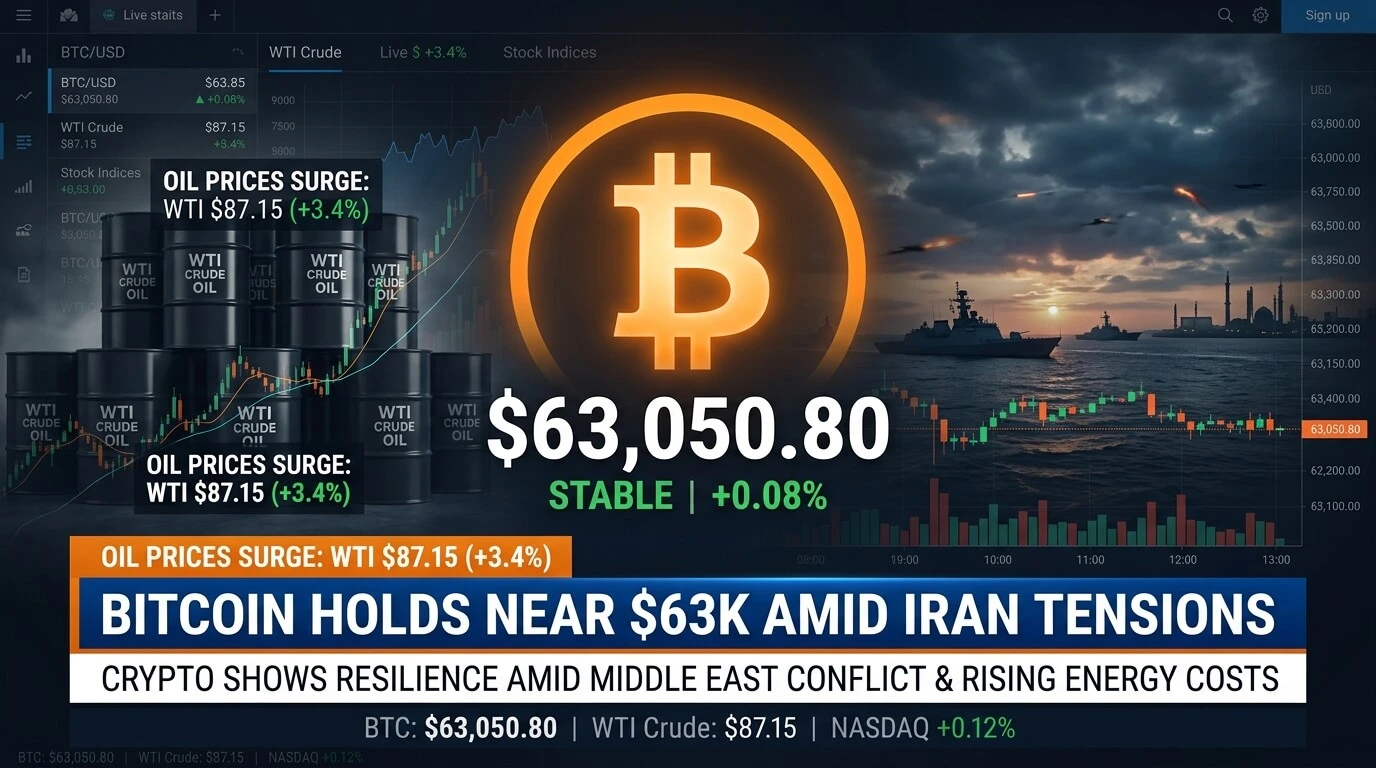
Bitcoin stayed relatively calm near the $63,000 mark over the past day even as fresh US strikes on Iran sent oil prices higher and rattled global markets. The leading cryptocurrency traded in a tight range around $62,000 to $63,000, showing resilience amid geopolitical tensions and ahead of key US economic data.
Traders kept a close eye on developments in the Middle East while bracing for the latest CPI inflation numbers and any hints from the Federal Reserve on interest rates. This combination created a cautious mood across crypto, yet Bitcoin avoided sharp drops that hit riskier assets.
Geopolitical tensions drive oil higher
The latest escalation between the US and Iran pushed crude prices up noticeably. Brent crude climbed as concerns grew over potential disruptions in the Strait of Hormuz, a vital route for global oil shipments. Higher energy costs often signal broader inflation risks, which can weigh on investor appetite for assets like Bitcoin.
In this environment, Bitcoin acted more like a hedge than a pure risk asset. While stocks and some altcoins faced selling pressure, BTC held its ground. Some market watchers noted that crypto participants viewed the conflict as contained for now, limiting the downside.
Bitcoin’s price action in detail
Over the last 24 hours, Bitcoin dipped briefly below $62,000 before bouncing back toward $63,000. Trading volume remained moderate, suggesting many investors chose to sit on the sidelines rather than make big moves. Support levels around $61,000 to $62,000 held firm, while resistance sat near $64,000 to $65,000.
Technical analysts pointed to bullish divergences on charts and fair value gaps that could support further upside if positive catalysts emerge. On the flip side, a breakdown below key supports might open the door to tests of $59,000 or lower. For now, the steady range reflected balanced forces between fear from geopolitics and hope around upcoming data.
Upcoming US CPI data and Fed expectations
Tomorrow’s June CPI release could sway sentiment significantly. Analysts expect headline inflation to show modest cooling, but any surprises higher might fuel worries about persistent price pressures. That scenario could delay Federal Reserve rate cuts, keeping borrowing costs elevated and pressuring growth-sensitive assets.
Bitcoin has historically reacted to Fed decisions. Lower rates tend to boost crypto by making riskier investments more attractive. With traders pricing in possible cuts later this year, the CPI print serves as an important checkpoint. A softer number could encourage buying, while hotter inflation might reinforce the recent consolidation.
Oil surge and its ripple effects on crypto
Rising oil prices affect crypto in multiple ways. Energy costs influence mining profitability since operations require substantial electricity. Higher prices could squeeze smaller miners, though many have hedged or shifted to efficient setups.
Broader economic impacts matter too. Elevated oil often correlates with inflation, prompting tighter monetary policy that hurts equities and crypto. Yet in uncertain times, some investors turn to Bitcoin as a store of value similar to gold, especially when traditional markets wobble.
This dynamic played out recently. Global markets shed over $1.5 trillion in value amid the Iran news, with some indices dropping sharply. Bitcoin’s relative stability stood out, reinforcing its maturing status.
How traders are positioning
Market sentiment remains mixed. On one side, geopolitical risks create short-term caution. On the other, long-term believers see any dips as buying opportunities given Bitcoin’s halving cycle effects and growing institutional interest.
Derivatives data showed balanced positioning. Funding rates stayed neutral, and open interest held steady without extreme leverage buildup. This lack of overcrowding reduced the chance of violent liquidations in either direction.
Some participants rotated into stablecoins or reduced exposure ahead of CPI, while others accumulated on weakness near $62,000. Altcoins generally underperformed, highlighting Bitcoin’s dominance in risk-off moments.
Broader market context
The Iran conflict added another layer of uncertainty to an already complex year for crypto. Earlier rallies driven by ETF inflows and corporate adoption faced tests from macroeconomic headwinds. Oil’s surge reminded everyone how external events can override internal crypto narratives.
Despite that, Bitcoin’s correlation with stocks loosened at times, behaving more independently. This decoupling, even if partial, appeals to portfolio managers seeking diversification.
Risks and what to watch next
Volatility remains the constant. A rapid de-escalation in the Middle East could lift sentiment and push Bitcoin toward $65,000. Conversely, prolonged tensions or worse-than-expected CPI might drag prices lower.
The Fed’s path on rates will dominate headlines through the rest of the year. Any signals of patience on cuts could extend consolidation, while dovish tones might spark a relief rally.
Investors should also monitor mining metrics and on-chain activity. Hash rate trends and whale movements often provide early clues about underlying strength.
Practical takeaways for crypto participants
In times like these, risk management matters most. Setting clear stop levels, avoiding excessive leverage, and maintaining cash reserves help weather storms. Diversification across assets, including some exposure to commodities or bonds, can balance portfolios.
For longer-term holders, dips amid noise often represent accumulation zones. Bitcoin’s history shows it weathers geopolitical events and emerges stronger when fundamentals like adoption improve.
The current hold near $63,000 demonstrates resilience. As the Iran situation evolves and US data arrives, Bitcoin will likely react but not necessarily follow traditional markets blindly. Traders and investors alike will parse every headline for clues about the next move in this volatile but maturing asset class.