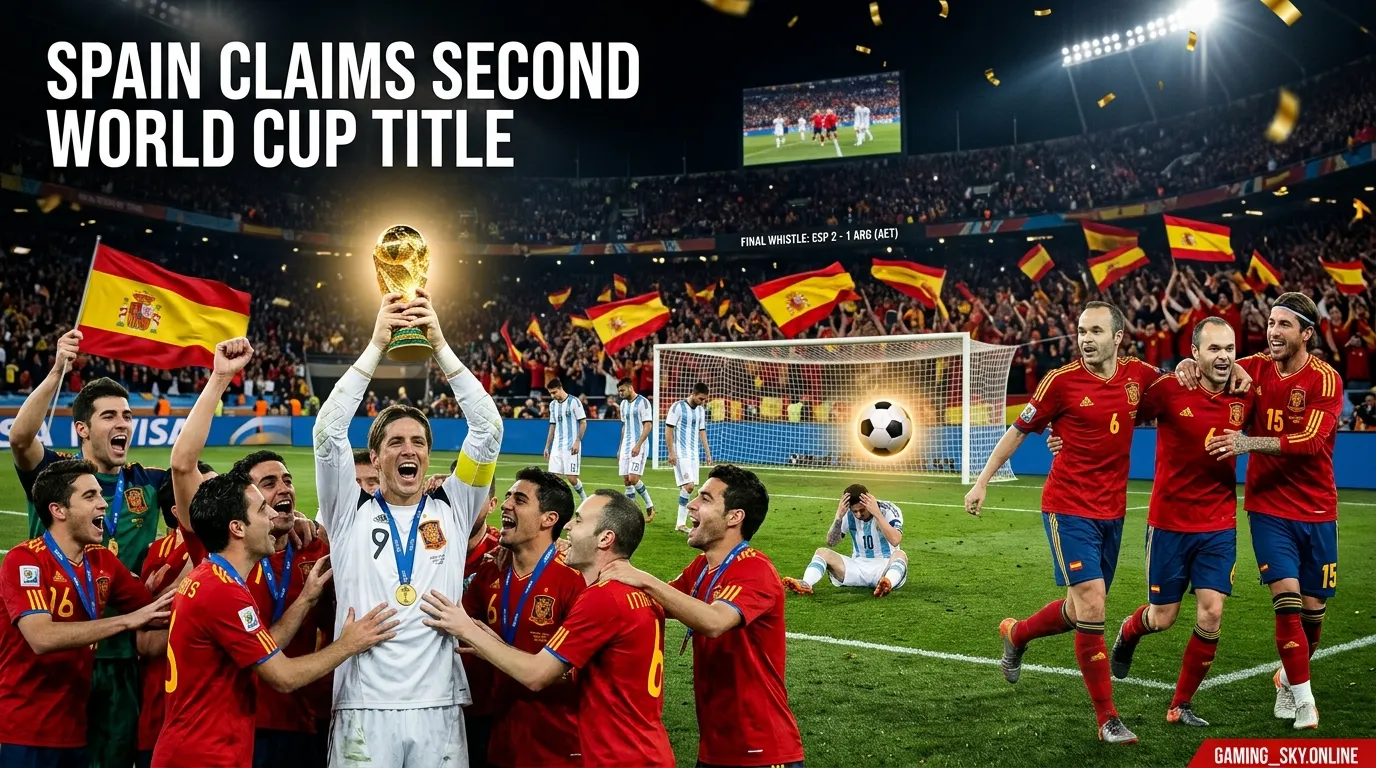
Spain are world champions once again. In a tense, tightly contested final at MetLife Stadium in New Jersey, substitute Ferran Torres struck in the 106th minute to secure a 1-0 victory over defending champions Argentina and deliver La Roja their second World Cup title.
It was the kind of night where possession and pressure finally paid off after regulation time failed to produce a breakthrough. Spain dominated the ball and created the clearer chances, but Emiliano Martínez stood tall in the Argentine goal with a string of important saves. Torres, coming off the bench, made the difference when it mattered most.
The game followed a familiar pattern for this Spanish side. They controlled the tempo, moved the ball with precision, and restricted Argentina to very little. Lionel Messi, at 39, was asked to do a lot in what may have been his final World Cup appearance, but the energy and organization of the younger Spanish squad proved too much. Argentina managed zero shots on target until late in extra time, a remarkable defensive effort from Spain that saw them concede just one goal across the entire tournament.
Lamine Yamal, the teenage sensation who has lit up the competition, was influential once more alongside Nico Williams. Their direct running and ability to stretch the play kept Argentina on the back foot. When the breakthrough finally came, it felt earned rather than lucky. Pedro Porro delivered a dangerous cross, Williams got his head to it, and the ball dropped perfectly for Torres to side-foot home. Bedlam on the Spanish bench. Pure relief mixed with joy.
For Argentina, the disappointment was obvious. They fought hard, defended resolutely, and relied on moments of individual brilliance, but ultimately came up short against a more complete team. The sending off that left them with 10 men didn’t help their cause in extra time, though by then Spain already looked the fresher side. Messi walked off the pitch knowing he had given everything, but this generation’s story ends without a second straight title.
Rodri was named the tournament’s best player, collecting the Golden Ball in recognition of his midfield mastery. Unai Simón earned the Golden Glove for his reliable work between the posts, while young defender Pau Cubarsí took home Best Young Player honors. These individual awards tell part of the story, but the real credit goes to the collective.
Spain’s path to glory wasn’t always straightforward. They showed maturity beyond their years, blending exciting attacking talent with a rock-solid defensive structure. Manager Luis de la Fuente deserves praise for building a team that could handle the pressure of a World Cup final. Their style, rooted in technical superiority and tactical discipline, overwhelmed opponents throughout the knockout stages.
Think back to the group phase and earlier rounds. Spain rarely looked rattled. They absorbed pressure when needed and struck with speed on the counter. Against Argentina, that approach reached its peak. The final felt like a heavyweight bout where one fighter had the reach and footwork to keep the other at bay until the decisive blow landed.
Torres’ goal will live long in the memory. Coming on as a substitute, he didn’t need much time to make his mark. “Destiny was written,” he said afterward, capturing the sense that this Spanish team was built for moments like these. It echoes Fernando Torres’ contribution in 2010, another substitute delivering in a major final. History has a nice way of rhyming sometimes.
The celebrations in Spain were instant and widespread. Fans poured into the streets of Madrid, Barcelona, and every town in between. Fireworks lit up the night sky as the players lifted the trophy, with Yamal and his brother sharing emotional family moments on the pitch. Social media exploded with clips of the goal, the saves, and the pure elation. Even some lighthearted edits removing unrelated figures from trophy photos made the rounds.
This win comes just two years after Spain’s Euro 2024 triumph. It’s a golden period for Spanish football, driven by a blend of established stars and exciting young prospects coming through the academy system. The future looks bright, but for now, the focus is on savoring this achievement.
Argentina can hold their heads high despite the loss. Reaching back-to-back finals is no small feat, especially with an aging core. Messi’s legacy remains untouchable, and the next generation, including players like Nico Paz, already talk about coming back stronger. Football moves on quickly, and the pain of this night will fuel ambitions for 2030.
What stood out most was Spain’s ability to stay patient. They didn’t panic when chances didn’t go in during normal time. Instead, they kept probing, maintained their shape, and waited for the opening. Torres’ finish was clinical, low and precise, giving Martínez no chance. It capped a performance where Spain created far more threat without overcommitting.
Tactically, Spain’s high press and quick transitions disrupted Argentina’s rhythm. Messi found himself dropping deeper to influence play, which limited his threat in the final third. Argentina’s defense, marshaled well for long periods, eventually cracked under the sustained pressure.
For neutral fans, it was a final that delivered drama in the extra period rather than a goal-fest. Sometimes the best games are the tense ones where every tackle and save feels massive. Martínez’s heroics kept Argentina alive, but even he couldn’t stop the inevitable as legs tired and spaces opened up.
Spain join an elite group as repeat winners in the modern era. Their 2010 triumph in South Africa feels like a lifetime ago, but this squad has its own identity. Youthful exuberance balanced with experienced leadership. It’s a model many nations will study.
As the players paraded the trophy, the emotions were raw. Joy for Spain, heartbreak for Argentina. That’s the beauty and cruelty of a World Cup final. One moment defines months of preparation and a nation’s hopes.
Looking ahead, the 2026 tournament will be remembered for the emergence of new stars, record crowds in the expanded format, and Spain’s clinical efficiency. They didn’t always score plenty, but they scored when it counted.
Ferran Torres, the match-winner, summed up the night perfectly. A player who has had ups and downs at club level stepped up on the biggest stage. That’s what World Cups do. They create heroes in unexpected ways.
Congratulations to Spain. They were the deserving champions, built on solid foundations and inspired moments. For Argentina and Messi, the journey ends, but their impact on the game endures. The 2026 World Cup is over, but the memories, and the debates, will last for years.