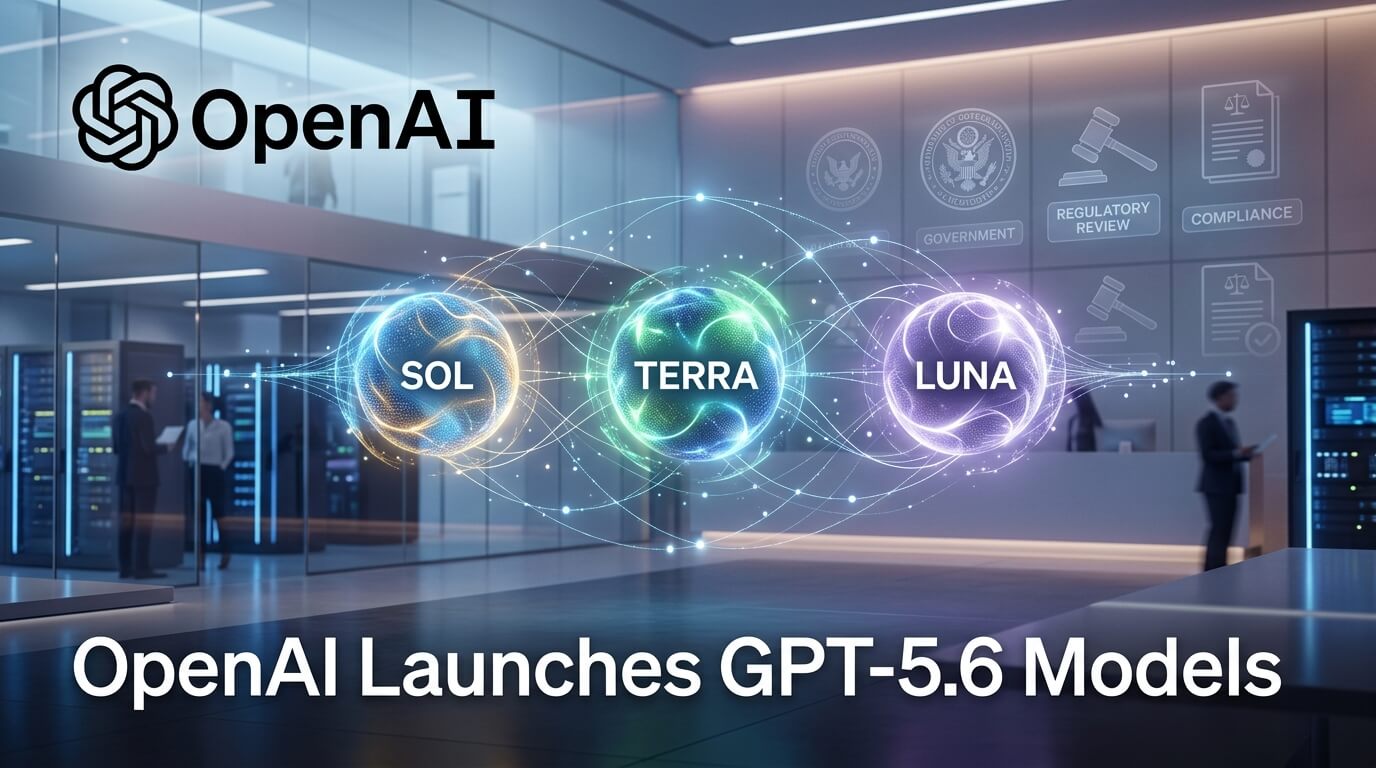
OpenAI has started rolling out its new GPT-5.6 family of models, named Sol, Terra, and Luna, following a period of additional government testing and consultations. The release marks a significant step in making advanced AI more widely available while addressing safety and security concerns raised by U.S. officials. Users can now access these models across ChatGPT, the API, and Codex, with the rollout happening gradually worldwide.
This launch comes after OpenAI worked closely with the government on a phased approach. The process reflects growing oversight of powerful AI systems, especially those with strong cybersecurity capabilities.
Understanding the GPT-5.6 Model Family
The GPT-5.6 lineup includes three distinct models designed for different needs. Sol serves as the flagship, built for the toughest reasoning tasks, complex coding, agent workflows, and research. It features advanced modes like max reasoning effort and ultra sub-agent capabilities that let it tackle long-horizon problems by coordinating multiple streams of thought.
Terra strikes a balance, offering strong performance for everyday work at a more affordable price. OpenAI says it delivers results competitive with previous top models while costing roughly half as much in many cases. Luna focuses on speed and efficiency, making it ideal for high-volume tasks, quick chats, summaries, and lighter workloads where cost and response time matter most.
This tiered approach gives developers and users more flexibility. Instead of one-size-fits-all, you can route different jobs to the right model based on complexity, budget, and urgency.
The Government Review Process
Before the broad rollout, OpenAI previewed the models’ capabilities to U.S. government officials and limited initial access to a small group of trusted partners. This step followed an executive order from President Donald Trump aimed at creating a framework for evaluating frontier AI models, particularly those with advanced cyber abilities.
The review lasted around 12 days in some reports and involved technical engagements between OpenAI engineers and agencies. It was technically voluntary but set a clear precedent for how major releases will be handled going forward. OpenAI has stated it does not want this kind of process to become the permanent default, as it could slow down innovation and limit access for defenders and developers who need these tools.
The company strengthened safety guardrails in GPT-5.6, especially around higher-risk activities, cyber requests, and potential misuse. Sol comes with the most robust protections yet, including better resistance to real-world attacks.
Performance Improvements and Real-World Impact
Early feedback and benchmarks highlight meaningful gains. Sol has shown strong results on coding and reasoning tests, with fewer hallucinations than earlier versions. One notable achievement involved solving a long-standing math conjecture in under an hour, with OpenAI publishing the verifiable proof.
Users have reported faster Blender renders, better agent performance, and more reliable outputs for complex tasks. On the flip side, heavy demand caused some server limits and usage resets shortly after launch, which is common with big rollouts.
Pricing follows the tier structure. Sol sits at the higher end, Terra offers good value in the middle, and Luna keeps costs low for volume work. This setup helps enterprises manage expenses while scaling AI use across teams.
Why the Tiered Strategy Matters
OpenAI’s decision to release a family of models rather than a single flagship addresses practical realities. Not every task needs maximum intelligence, and running everything on the most powerful version gets expensive fast. Terra and Luna let organizations optimize for cost without sacrificing too much capability.
This mirrors trends across the industry, where efficiency and accessibility are becoming as important as raw power. For developers building agents or handling large-scale operations, having options within the same generation simplifies workflows.
Broader Context and Future Outlook
The GPT-5.6 rollout happens amid intense competition and regulatory attention. Other companies have released strong models recently, pushing the frontier forward quickly. Government involvement signals that advanced AI is now seen as critical infrastructure with both huge potential and real risks.
OpenAI plans to expand availability over the coming days and weeks, with full access rolling out gradually. The company continues coordinating with partners and officials to refine the process for future releases.
For regular users, this means more powerful tools in ChatGPT for writing, coding, analysis, and creative work. Enterprises gain better options for secure, efficient deployment. Researchers and defenders benefit from stronger cybersecurity features.
Sol, Terra, and Luna represent OpenAI’s latest effort to push capabilities while navigating the new reality of oversight. The phased release after government review sets an interesting template. How it plays out could influence the speed of innovation and the balance between safety and broad access in the months ahead.
Demand has been high, and early adopters are already sharing impressive results. As the models settle in and usage stabilizes, expect more real-world examples of how these tiers change daily AI work. The GPT-5.6 family gives users real choices, and that flexibility could prove just as valuable as the intelligence gains.